
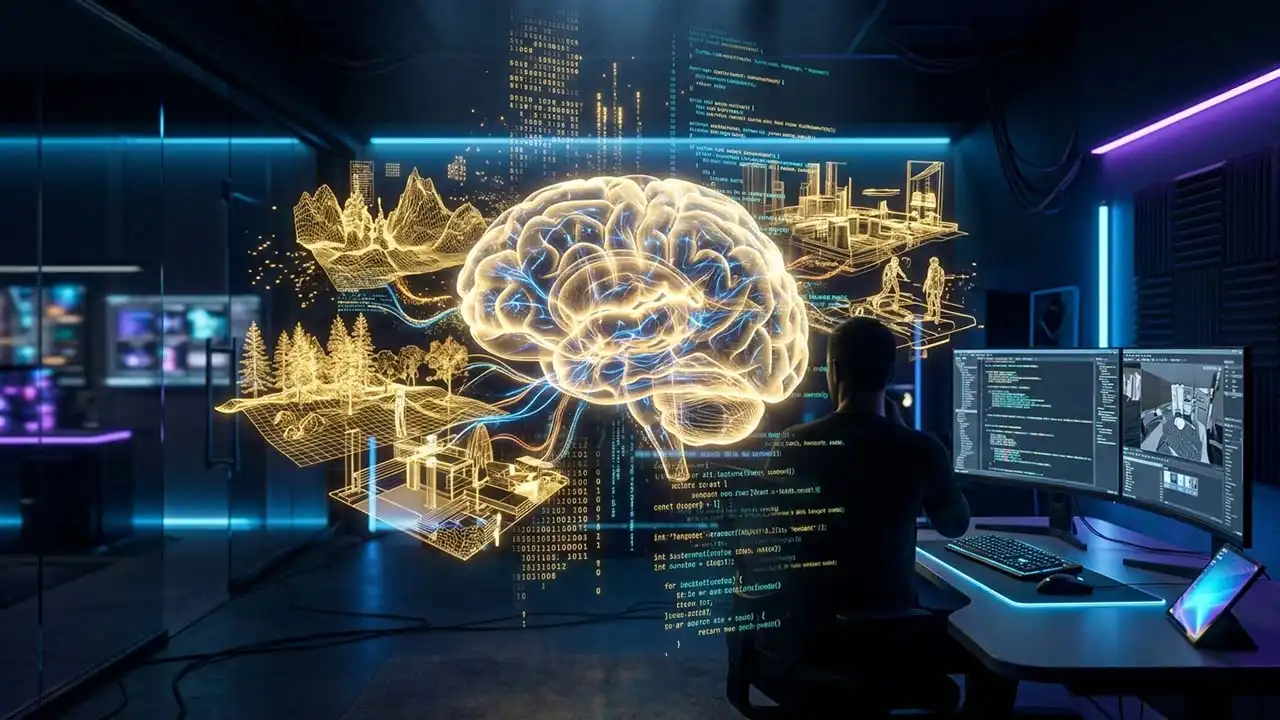
In the fast-paced world of technology, 2026 marks the definitive “Year of the AI Engine.” We have officially moved past the era where Artificial Intelligence was merely a marketing buzzword used to describe basic enemy pathfinding. Today, AI in game development has evolved into a foundational pillar, fundamentally altering the pipeline from the first line of code to the final player interaction.
For the tech-savvy audience at Tethub, understanding this shift is crucial. We aren’t just seeing faster development cycles; we are witnessing the birth of “Living Games”—titles that breathe, learn, and adapt.
1. The Generative Explosion: From Days to Seconds
The most significant bottleneck in traditional game design was always asset creation. Building a high-fidelity open world required thousands of artists and years of manual labor.
Automated Environmental Design and NeRFs
With Generative AI for gaming, the paradigm has shifted. Tools like Neural Radiance Fields (NeRFs) and advanced diffusion models now allow developers to transform a few 2D photographs into fully navigable 3D environments. This isn’t just about speed; it’s about complexity. AI-driven game development tools can now handle the placement of every leaf, the flow of every stream, and the realistic weathering of stone walls without human intervention, ensuring that automated level design reaches a level of detail that was previously physically impossible.
The Rise of “Prompt-to-World” Engines
Imagine a lead designer typing, “Create a neo-noir cyberpunk city with rain-slicked streets and 1980s retro-futurist neon lighting,” and seeing a base map generated in real-time. This is the reality of 2026. This democratization allows indie developers to compete with AAA giants, shifting the focus from “who has the most money” to “who has the best idea.”
2. Breaking the Fourth Wall: The Rise of Cognitive NPCs
If you played games in 2020, you remember NPCs (Non-Player Characters) with limited dialogue and repetitive loops. In 2026, the AI-driven NPC has become a sentient-feeling entity.
LLM Integration and Memory Systems
By integrating specialized Large Language Models (LLMs) directly into the game’s logic, characters no longer rely on pre-written scripts. They possess “Contextual Memory.” If you steal an item from a shopkeeper in the first hour of gameplay, that character might remember your face, alter their tone, or even hire mercenaries to track you down ten hours later.
This level of machine learning in games creates a sense of accountability and immersion. The dialogue is dynamic, voice-synthesized in real-time with perfect emotional inflection, making every interaction unique to your specific playthrough.
3. Real-Time Optimization: The Death of the “Loading Screen”
We’ve long sought the “seamless” experience. In 2026, AI in game development has finally killed the loading screen through predictive data streaming.
Neural Rendering and DLSS 5.0
Modern game engines now use AI to predict where a player is looking and only render those pixels at maximum quality. This “foveated rendering” on a software level—driven by neural networks—allows 8K visuals to run on hardware that would have struggled with 4K just years ago. The integration of AI-driven graphics optimization means that “system requirements” are becoming less about raw power and more about how well your GPU interacts with AI upscaling algorithms.
4. Hyper-Personalization: A Game Designed Just for You
Perhaps the most “scary” yet exciting development is Player-Centric AI Adaptation. The game’s director is no longer a human in an office; it’s an AI agent watching your every move.
- Adaptive Difficulty 2.0: If the AI detects your heart rate increasing (via wearable integration) or notices you’ve failed a jump three times, it subtly modifies the gravity or the enemy’s reaction time.
- Procedural Content Generation (PCG) on the Fly: The story itself can branch based on your psychological profile. Are you a player who enjoys lore? The AI will generate more books and environmental storytelling. Do you prefer action? It will trigger more dynamic combat encounters.
5. The Economic Shift: Budgeting in the AI Era
The cost of developing a AAA game once soared toward $500 million. Today, automated game testing (QA) and AI-assisted coding have started to bend that curve downward.
AI as a Co-Pilot for Coders
Software like “GitHub Copilot for Games” now suggests entire physics modules or shader codes, reducing the time spent on “boilerplate” programming. This allows studios to reallocate their budgets toward human-driven creativity—better writing, more innovative mechanics, and deeper emotional storytelling.
6. Challenges and the “Uncanny Valley” of Ethics
As an SEO expert and industry analyst, I must highlight the friction points. The transition to AI-centric game design isn’t without its casualties.
- The Workforce Dilemma: Junior roles in art and QA are being replaced by AI oversight roles. The industry is currently struggling to redefine the “entry-level” position.
- Copyright Ambiguity: As AI generates textures and music, the legal battle over “training data” remains a hot topic in 2026. Tethub continues to monitor how international laws are catching up to these digital creations.
- The Soul Factor: Can an AI-generated story truly move a human to tears? While AI can simulate structure, the “spark” of human experience remains the most valuable asset in the gaming market.
Conclusion: The New Golden Age of Gaming
AI in game development has officially moved from a “feature” to the “foundation.” In 2026, we are seeing games that are more immersive, more personal, and more expansive than ever imagined. For developers, AI is the ultimate power-up; for players, it is the key to worlds that finally feel alive.
As we continue to cover these trends at Tethub, one thing is certain: the line between the virtual and the real has never been thinner, and AI is the needle sewing them together.
Frequently Asked Questions
1. Is AI making games better or just cheaper to produce?
AI is doing both. It reduces production time and costs through automation, but more importantly, it enables dynamic NPC behavior, smarter world-building, and personalized gameplay—leading to richer and more immersive player experiences.
2. Will future games be fully generated by AI?
Not entirely. While AI can generate environments, dialogue, and assets, human designers are still essential for creative direction, storytelling depth, and emotional authenticity. The future is hybrid development—AI tools guided by human vision.
3. Do AI-driven games collect personal player data?
Some adaptive systems analyze gameplay behavior (like movement patterns or decision styles) to personalize difficulty and content. However, reputable studios follow data protection regulations and typically anonymize player data to protect privacy.