
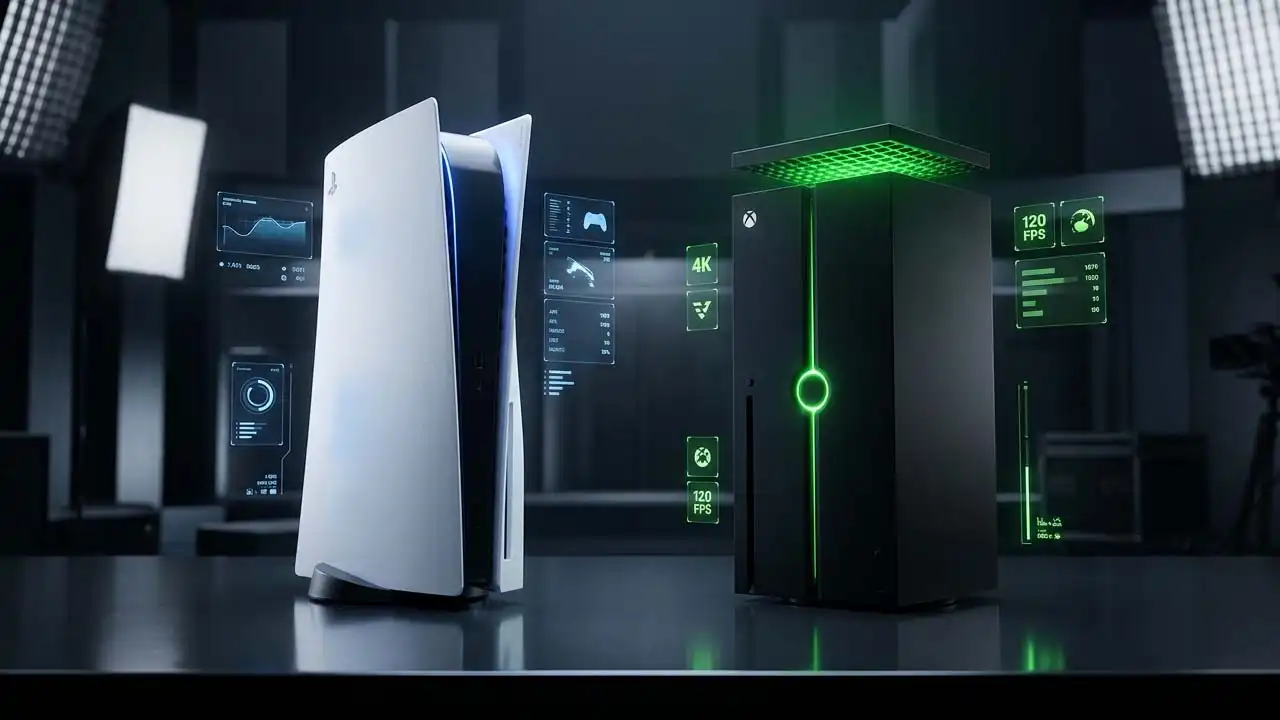
If you’ve been following gaming industry news lately, you’ve probably noticed that discussions about the next generation of consoles are slowly gaining momentum. While official announcements are still years away, leaks and analyst reports about Sony’s PlayStation 6 and Microsoft’s next Xbox—often referred to as Project Helix—are already shaping expectations.
Interestingly, the conversation around next‑gen hardware may look very different from previous console cycles. Instead of focusing purely on graphical fidelity, many analysts believe the real competition could center on performance—specifically high frame rates at 4K resolution.
In other words, the next console battle might be less about which system produces the prettiest image and more about which platform can deliver the smoothest gameplay.
Raw Power: Microsoft May Aim for the Stronger Hardware
Based on current rumors and hardware analysis, Microsoft appears to be targeting higher raw performance with its next console. Some reports suggest that Xbox Project Helix could be roughly 30% more powerful than the PS6 in GPU performance.
One of the reasons often cited is the difference in Compute Units (CU) inside the GPU architecture.
According to leaks:
- Xbox Project Helix may feature around 70 Compute Units
- PS6 could ship with approximately 54 Compute Units
In GPU architecture, more compute units typically translate to higher parallel processing capability, which can help with rendering complex scenes, higher resolutions, and more demanding visual effects.
There are also claims that Microsoft may pair the GPU with a stronger CPU configuration, potentially giving the system an advantage in CPU‑heavy scenarios such as large open‑world simulations or physics‑intensive gameplay.
However, as console history has shown many times, raw hardware specs rarely tell the whole story.
The Real Battlefield: High Frame Rates at 4K
Perhaps the most interesting claim surrounding next‑gen consoles is the performance target each company might pursue.
Some analysts suggest that Microsoft could aim for 4K gaming at up to 144 frames per second with its next Xbox hardware.
Meanwhile, Sony’s PS6 may focus on delivering 4K at 120 FPS as a stable performance target.
On paper, the difference between 120 FPS and 144 FPS might not sound dramatic. But for certain genres—especially competitive shooters, racing games, and fast‑paced multiplayer titles—higher frame rates can noticeably improve responsiveness and smoothness.
That said, many experts believe the visual difference between the two consoles will likely be minimal in most real‑world scenarios. For many players, the biggest distinction may simply come down to how consistently each system maintains its target frame rate.
This suggests the next generation might prioritize performance stability and responsiveness rather than massive graphical leaps.
Sony’s Potential Advantage: Optimization and PSSR
If Microsoft pushes raw hardware power, Sony may rely more heavily on software optimization and image reconstruction technologies.
One feature frequently mentioned in PS6 discussions is PSSR (PlayStation Spectral Super Resolution).
PSSR is believed to be an advanced upscaling technology that allows games to render internally at a lower resolution and then reconstruct the final image to near‑4K quality using AI‑assisted algorithms.
This approach offers two major advantages:
- It reduces the workload on the GPU
- It helps maintain higher frame rates without sacrificing visual quality
As a result, even if Xbox Project Helix ends up with stronger raw hardware, Sony could potentially close the gap using smart rendering techniques and highly optimized game engines.
Historically, Sony has often been praised for how efficiently developers are able to optimize games for PlayStation hardware, which could once again play a major role in the next generation.
Pricing Could Decide the Winner
While hardware performance generates headlines, price is often the factor that truly determines success in the console market.
If Xbox Project Helix does indeed use significantly larger and more powerful hardware, production costs could also increase. That might force Microsoft to choose between:
- Launching the console at a higher retail price, or
- Absorbing some of the cost to keep the system competitively priced
Sony, on the other hand, may try to maintain its advantage through a combination of competitive pricing, exclusive titles, and its established PlayStation ecosystem.
Game libraries, services, and brand loyalty often influence buying decisions just as much as hardware performance.
For Now, It’s All Speculation
It’s important to remember that none of these specifications have been officially confirmed.
Most of the information currently circulating comes from industry leaks, analyst discussions, and reports from tech outlets. Sources such as Moore’s Law Is Dead and other hardware analysts frequently discuss potential designs, but until Sony or Microsoft reveal their next‑generation plans, these details remain unconfirmed predictions.
Console hardware can change significantly during development, and final specifications often differ from early reports.
Final Thoughts
If current rumors prove accurate, the PS6 vs Xbox Project Helix rivalry could represent a shift in how console generations evolve.
Instead of massive graphical jumps, the next generation might focus more on high frame rates, performance efficiency, and smoother gameplay experiences.
- Xbox Project Helix may deliver around 30% more raw GPU power
- The CU difference could be roughly 70 vs 54
- Performance targets might reach 4K/144 FPS vs 4K/120 FPS
- Sony could rely on technologies like PSSR to compensate through smarter rendering
- Ultimately, price, exclusives, and ecosystem strength may matter more than raw specs
It’s still far too early to declare a winner, but one thing seems increasingly clear: the next console generation could be defined not by graphics alone, but by how smoothly and consistently games run.
FAQ
1. Is Xbox Project Helix more powerful than PS6?
Some leaks suggest Xbox Project Helix could have around 30% more raw GPU power than the PS6, but no official specifications have been confirmed yet.
2. What frame rates could next‑gen consoles target?
Rumors indicate Xbox Project Helix may aim for 4K at 144 FPS, while PS6 could focus on 4K at 120 FPS, though real‑world performance will depend on each game.
3. What is PSSR on PS6?
PSSR (PlayStation Spectral Super Resolution) is a rumored AI‑based upscaling technology that could allow PS6 to render games at lower resolutions and upscale them to near‑4K quality.
4. When will PS6 and the next Xbox release?
There is no official release date yet, but industry analysts expect the next generation of consoles to launch around 2027–2028.