
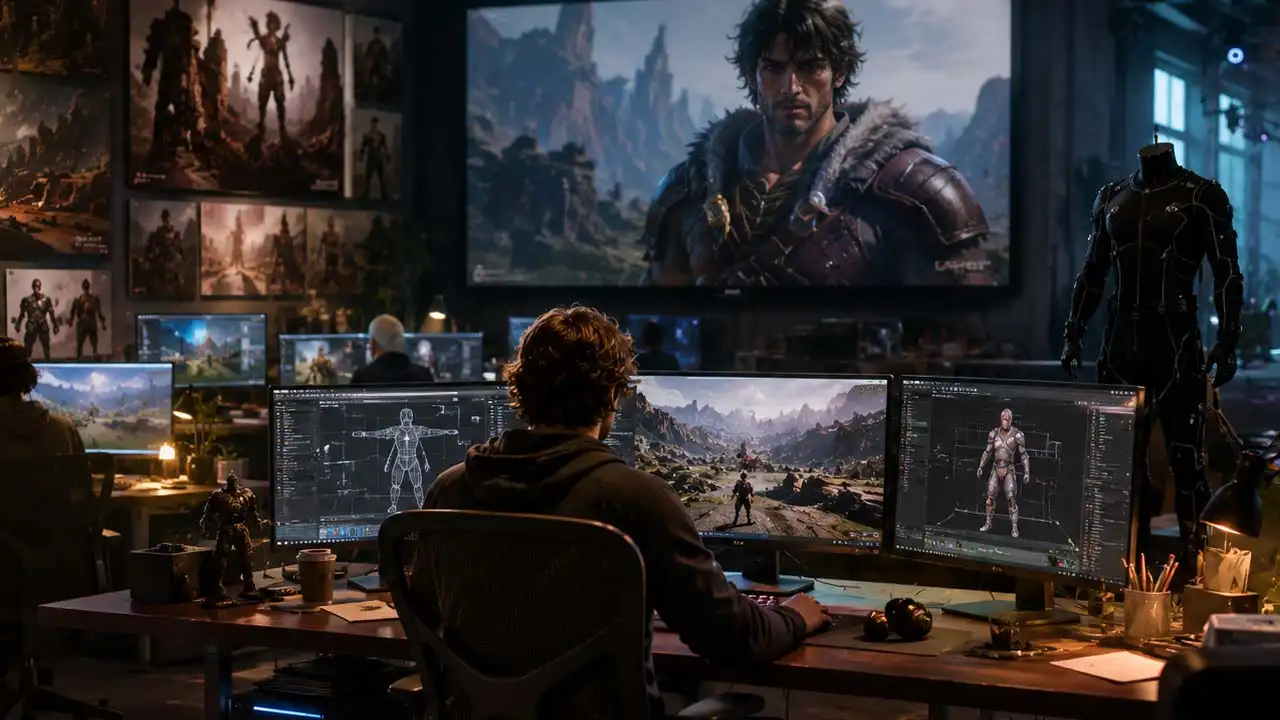
If you’ve been following the gaming industry for the past decade, you’ve probably noticed a pattern: AAA games take far longer to develop than they used to. What once could be created in two or three years can now stretch into five, six, or even ten years of production. Fans often ask the same question every time a highly anticipated title is delayed again: why does it take so long?
The answer is not simple. Modern AAA game development is more ambitious, more expensive, and more technically demanding than ever before. Today’s blockbuster games are expected to deliver massive open worlds, cinematic storytelling, realistic animations, online features, and near-flawless performance across multiple platforms. That level of expectation comes with a huge cost in time, money, and manpower.
In this article, we’ll break down the main reasons AAA games take so long to develop, why delays have become so common, and what this means for the future of the industry.
The Scope of AAA Games Is Much Bigger Now
One of the biggest reasons AAA games take years to make is simple: the games themselves are much bigger than they used to be.
A modern AAA title is not just a game with better graphics. It’s often expected to be:
- open-world or semi-open-world
- visually photorealistic
- packed with voice acting and motion capture
- supported on multiple platforms
- polished at launch
- live-service ready or expandable with updates
That means development teams are no longer building just levels and mechanics. They are building entire ecosystems. Every city, vehicle, weapon, animation, NPC interaction, and menu system has to meet a high standard. The bigger the scope, the longer the production cycle.
This is one reason why many big budget video games spend years in pre-production before the actual full-scale development even begins.
Higher Expectations Mean More Polishing
Gamers are more demanding than ever, and publishers know it. A AAA title launching in a buggy or unfinished state can damage a studio’s reputation instantly. That’s why so much time is now spent on polishing, bug fixing, balancing, and optimization.
In the past, players accepted a few rough edges. Today, a broken launch can dominate social media within hours. That pressure forces studios to delay releases rather than ship an incomplete product.
This is one of the clearest answers to why games get delayed. It’s not always because a project is failing. In many cases, the team simply needs more time to meet the quality bar expected from a modern blockbuster release.
Game Worlds Are More Complex Than Ever
A huge reason for the rising AAA game development cycle is complexity.
Modern games often include:
- advanced AI systems
- dynamic weather and physics
- large-scale combat
- branching narratives
- cinematic cutscenes
- cross-platform support
- accessibility features
- photo mode, replay tools, and multiplayer infrastructure
Each of these systems needs to work together without breaking the game. That takes planning, engineering, testing, and iteration. Even one system can create a chain reaction of problems across the whole game.
For example, changing how combat works may affect AI behavior. Adjusting AI may affect mission scripting. Mission scripting may affect performance. Performance issues may then force graphical changes or engine optimization work. This ripple effect is one reason modern AAA game production takes so much longer than in the past.
Engines and Technology Have Become More Demanding
Another major factor is technology.
Modern games are often built on advanced engines that support high-end graphics, massive environments, real-time lighting, and detailed physics simulation. While these tools help developers create amazing worlds, they also increase development time because everything must be optimized, tested, and integrated carefully.
In addition, studios frequently spend time upgrading or customizing engines for a specific project. A new engine version can improve visuals, but it also introduces technical risks and bugs. If a project depends on custom technology, the development timeline becomes even more unpredictable.
This is especially true for studios building ambitious AAA game budgets around experimental features or next-gen design goals.
Teams Are Bigger, But That Doesn’t Always Mean Faster
It might seem logical that bigger teams would make games faster. In reality, that’s not always true.
AAA projects often involve hundreds or even thousands of people across:
- design
- programming
- art
- animation
- QA
- audio
- production
- localization
- marketing
Managing such a large team is difficult. Communication takes time. Coordination takes time. Decision-making takes time. When a project is this large, even small changes can require approval across multiple departments.
So while AAA studios are bigger than ever, the sheer scale of production means that growth doesn’t automatically shorten the schedule. In some cases, it can even slow things down if the pipeline is not carefully managed.
More Time Is Spent on Rework and Iteration
A lot of people imagine game development as a straight path from idea to finished product. In reality, it’s more like a cycle of trial, failure, feedback, and revision.
A mechanic may look good on paper but feel boring in practice. A level may work technically but fail to create the right atmosphere. A story mission may be too long, too short, or too repetitive. Each of these problems forces teams to revisit systems repeatedly.
This kind of iteration is normal in AAA game development, but it also extends the timeline. The more ambitious the game, the more likely it is to undergo major changes during development.
Sometimes a project can even be restarted internally if the original direction no longer works. That can add years to the schedule.
Open-World Design Is Extremely Time-Consuming
Many modern AAA games are open-world titles, and that alone adds a massive amount of development time.
An open world must be:
- large enough to feel meaningful
- filled with content
- visually consistent
- technically stable
- optimized for performance
- interesting to explore
Creating a believable open world requires level design, narrative design, environmental art, AI systems, quest logic, and world-building all working together. It’s not just about making a map bigger. It’s about filling it with experiences that feel worth the player’s time.
That’s why why AAA games take years to make is often easiest to understand when looking at open-world projects. These games are basically several games’ worth of content packed into one release.
Marketing and Publishing Add Pressure
The development timeline is not only about making the game. It’s also about launching it at the right time.
Publishers want to coordinate:
- trailers
- gameplay reveals
- review windows
- pre-orders
- platform marketing
- seasonal launch timing
Sometimes development is already close to finished, but the game is delayed for business reasons rather than technical ones. Releasing too close to a competitor, missing a holiday sales window, or skipping a major showcase can all affect the final schedule.
That’s another reason game development delays happen even when the game itself is progressing well.
Live-Service Features Make Development Even Harder
A growing number of AAA games are designed with multiplayer, online progression, or live-service systems in mind. That adds a whole extra layer of complexity.
Now developers must think about:
- server stability
- matchmaking
- anti-cheat
- post-launch updates
- seasonal content
- monetization systems
- network performance
These features require their own design, testing, and balancing. They also need to work alongside the single-player experience, if the game has one. That means more time, more testing, and more risk.
So when players ask why modern big budget video games take so long, live-service planning is often part of the answer.
AAA Development Is More Expensive Than Ever
Longer development cycles also reflect rising costs. A modern blockbuster game can cost tens or even hundreds of millions of dollars to produce and market.
With that level of investment, studios cannot afford to rush. Every additional month may increase costs, but a broken launch can be even more expensive in the long run. Delays are often used as a safety net to protect the product, the brand, and the business.
This is why AAA game budgets are closely tied to development time. The more money at stake, the more careful publishers become.
So, Will AAA Development Ever Get Faster?
Probably not in any major way.
If anything, the opposite may be true. Players continue to expect:
- larger worlds
- more realism
- better performance
- deeper stories
- smoother launches
- more content at release
Those expectations create enormous pressure on studios. Even with better tools and more powerful hardware, the ambition of modern games keeps increasing.
That doesn’t mean AAA development is broken. It means the industry has changed. The standard for what counts as a “complete” blockbuster game is much higher now than it was a generation ago.
Final Thoughts
There’s no single reason AAA games take so long to develop. It’s the result of many overlapping factors: bigger worlds, higher expectations, more complex technology, larger teams, heavier testing, and greater financial risk.
When a major release gets delayed, it can be frustrating for fans. But in many cases, that extra time is what allows the game to reach the quality level players expect from a modern AAA title.
So the next time you hear that a blockbuster release has been pushed back, remember: behind that delay is often an enormous production pipeline trying to make sure the final game actually lives up to the hype.
FAQ
1. Why are modern AAA games taking longer to make than older titles?
Because today’s games are larger, more complex, and require high‑end visuals, massive open worlds, advanced AI, voice acting, and cross‑platform optimization. All these elements dramatically increase production time.
2. Are delays always a sign of development problems?
Not necessarily. Many delays happen due to polishing, bug fixing, performance optimization, or marketing schedules. Delays often help ensure a smoother and more stable launch.
3. Will AAA game development ever speed up?
Unlikely. As player expectations grow and technology becomes more advanced, development cycles will remain long—unless studios drastically reduce scope or shift toward smaller, more focused experiences.